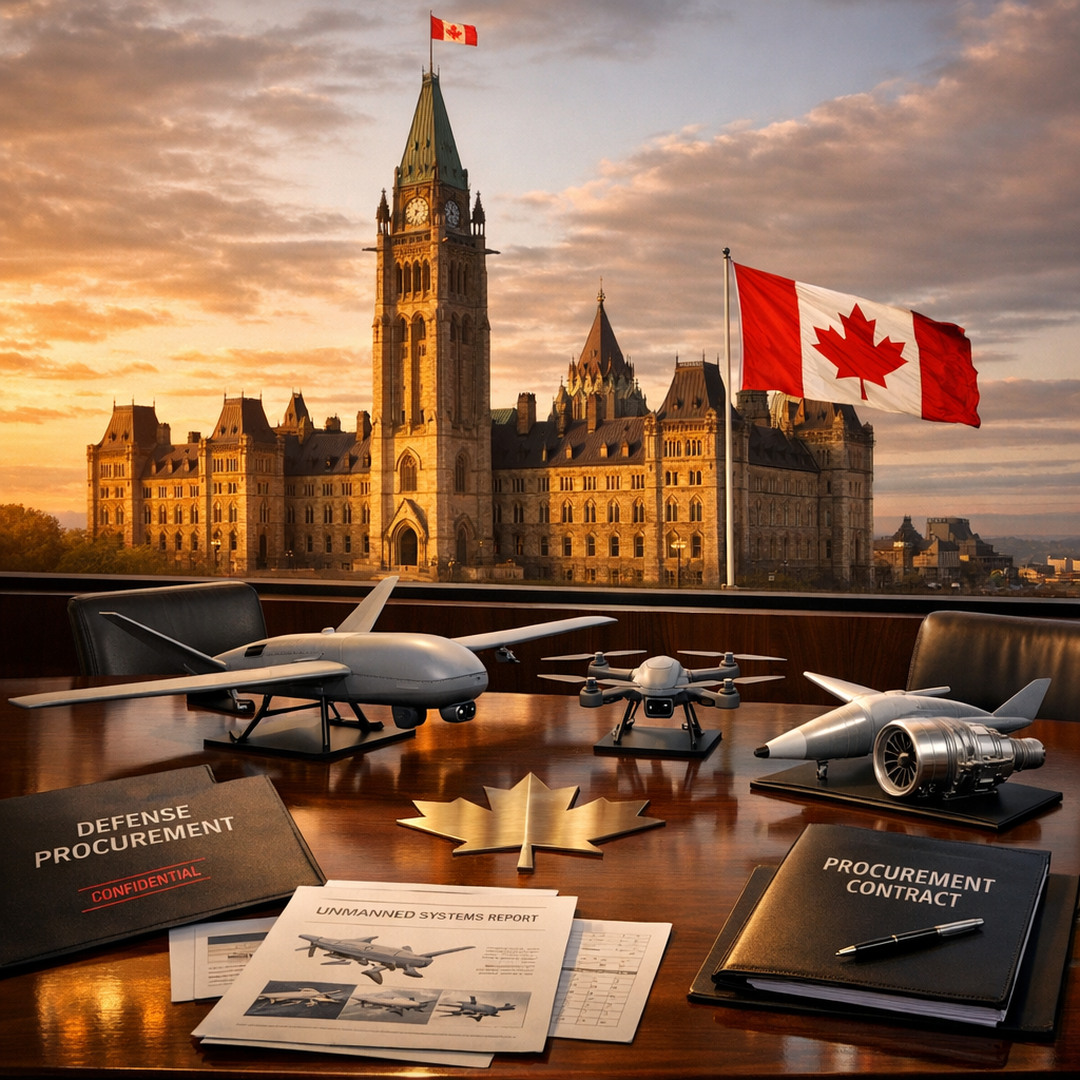



On November 3, 2026, the Canadian Defence Companies Alliance (CDCA) sent its first-ever national delegation of defence and dual-use companies to Parliament Hill in Ottawa. This historic initiative calls for better recognition of Canadian ownership and control in defence procurement, along with a clearer and more flexible path between technology testing and operational acquisition by the Canadian Armed Forces.
The delegation, which includes representatives from companies active in several strategic sectors such as aerospace, autonomous systems, marine and space technologies, advanced manufacturing, sensors and cybersecurity, will meet with senior federal officials and parliamentarians. The goal is to advance concrete recommendations stemming from an extensive dialogue conducted by the CDCA with nearly 90 Canadian companies across the country, as well as a national survey of its members.
A broadly shared industry concern
Throughout the consultations, the companies surveyed reported recurring difficulties securing contracts after successful military trials. They also point to a lack of visibility into procurement decisions and significant uncertainty regarding future defence demand. Many wonder whether current policies adequately account for Canadian ownership and control, particularly in priority sectors tied to the country's sovereign capabilities.
'Over the past few months, we have spoken with defence and dual-use companies from across Canada, ranging from technology startups to well-established manufacturers. Despite the diversity of their capabilities and experiences, their concerns are remarkably similar when it comes to procurement, access to opportunities and the predictability needed to invest and grow,' said Dasha Cohen, Executive Director of the CDCA.
A clear signal for jobs and investment
According to preliminary results of the CDCA's national survey of 49 defence and dual-use companies, greater predictability in future Canadian demand could translate into significant gains. Specifically, 86 percent of respondents say they would hire additional staff, 73 percent would develop new capabilities, 67 percent would expand their production or delivery capacity, and 67 percent would increase their research and development activities. For Quebec and Canadian aerospace, these figures represent a major opportunity for the creation of specialized jobs and the strengthening of the supply chain.
Strengthening Canadian industrial capacity
The CDCA is calling for defence procurement policies to draw a clear distinction between companies that merely operate in Canada and those that are owned and controlled by Canadian interests. Beyond ownership, the issue is about where intellectual property resides, where key decisions are made, and the real capacity to produce and maintain essential defence technologies on Canadian soil. As federal military spending rises significantly, these distinctions will help determine whether public funds are building sustainable Canadian industrial capacity.
From innovation to operational use
The CDCA proposes a tiered procurement approach, featuring streamlined processes for the awarding of smaller initial contracts, followed by larger orders as technologies meet operational and performance milestones. Early collaboration with Canadian Armed Forces personnel, clearer procurement timelines and more predictable demand would help companies develop technologies tailored to military needs and invest in scaling up production.
'Canada cannot claim to be sovereign in space if every satellite it depends on must be launched by a rocket owned by another country. Sovereignty means deploying and operating a capability without asking anyone's permission, and that is only possible if that capability is designed, built and controlled in Canada, from the intellectual property all the way to the software,' said Bachar Elzein, founder and CEO of Reaction Dynamics. 'Canadian companies are ready to deliver. What they need is a procurement system that rewards milestones achieved and sends a predictable demand signal.'
The delegation includes representatives from North Vector Dynamics, Dominion Dynamics, OVA, PV Labs, Kraken Robotics, Reaction Dynamics, Kepler Communications, JASCO Applied Sciences, Wuxly, Qohash and Canadian Strategic Missions Corporation (CSMC). Founded by its co-chairs Eliot Pence of Dominion Dynamics and Paul Ziadé of North Vector Dynamics, the CDCA represents approximately 200 Canadian-owned and controlled defence and dual-use companies.
To explore career opportunities in Quebec's aerospace and defence industry, visit aeroemploi.cathe leading job portal for your career in this strategic and fast-growing sector.