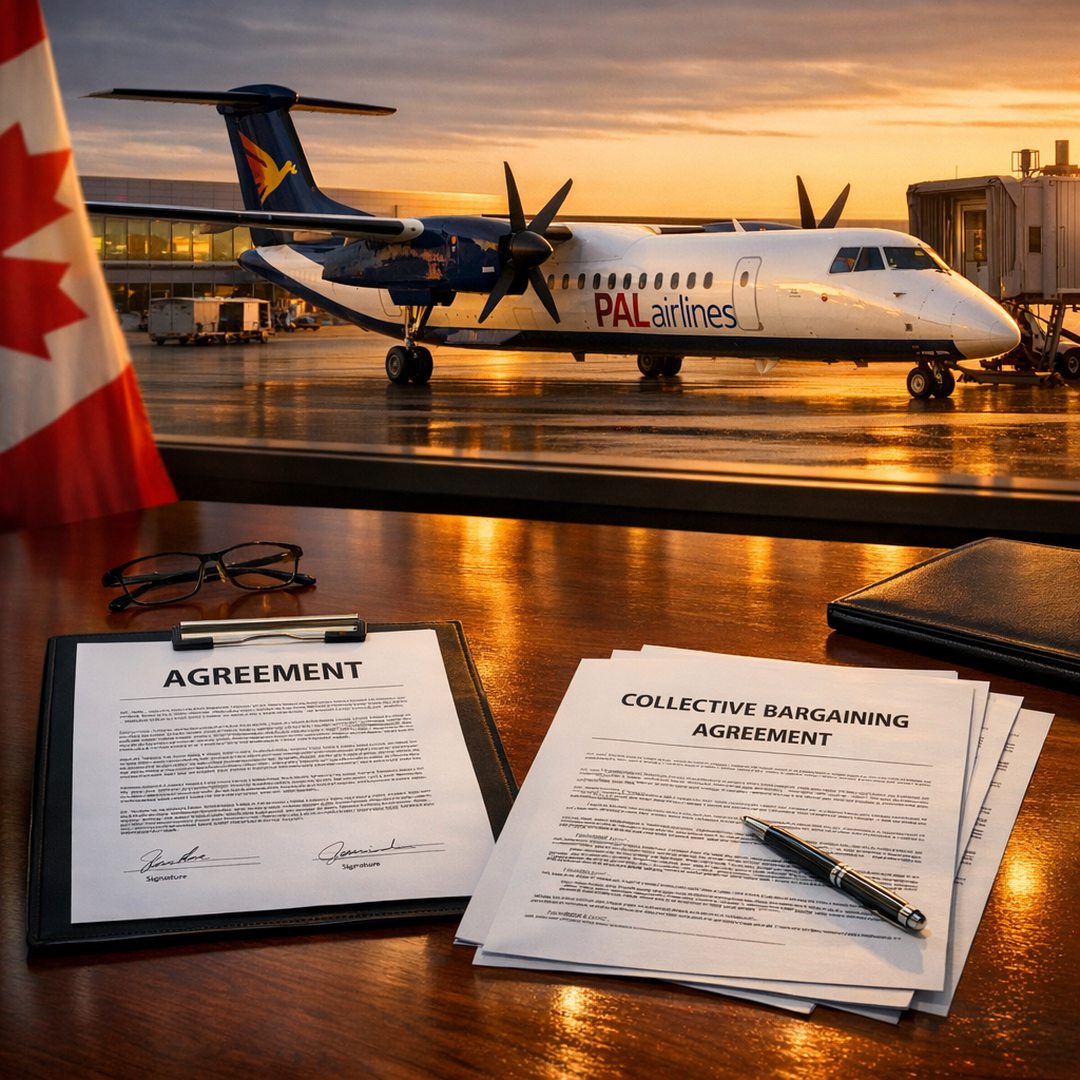



PAL Airlines and the Canadian Union of Public Employees (CUPE) have announced the conclusion of a tentative agreement to renew the collective agreement covering the regional carrier's flight attendants. The announcement marks an important milestone in labour relations at one of the most active airlines in Eastern Canada and on regional routes serving Quebec.
CUPE, through its Airline Division, represents the vast majority of flight attendants in Canada, including those employed at PAL Airlines. Negotiations had been underway for several months and focused notably on wages, scheduling, assignment rules and the recognition of ground duties, an issue that has become central in the Canadian airline industry.
A long-awaited agreement in a tense bargaining climate
This tentative agreement comes at a time when several Canadian airlines have recently negotiated or renegotiated collective agreements with their cabin crews. The air transport sector is undergoing a major transformation, marked by strong demand for qualified labour, increased competition on regional routes and growing pressure to improve working conditions for in-flight personnel.
The specific details of the agreement will not be made public until the union's members complete the ratification process. The flight attendants concerned will vote on whether to accept or reject the proposal in the coming weeks, in line with CUPE's standard procedure.
PAL Airlines, a strategic regional player
Founded in Newfoundland and Labrador, PAL Airlines operates a scheduled network covering several Eastern Canadian provinces, including Quebec. The carrier serves destinations such as Montreal, Quebec City, Sept-Îles and the Magdalen Islands, and also offers charter services and specialized flights, including maritime surveillance missions. Its fleet consists mainly of Dash 8 aircraft, well suited to regional routes and small to medium sized airports.
In Quebec, PAL Airlines plays an important role in serving remote regions and in supporting communities that depend on air transport for travel, supply chains and medical evacuations. Maintaining strong labour relations with its crews is therefore essential to the continuity of its day to day operations.
A broader issue for cabin crews
The question of compensation for ground duties, meaning the tasks performed by flight attendants before takeoff and after landing, has become a central theme in recent industry negotiations. Several union campaigns have highlighted that these hours, long unpaid or only partially paid, represent a significant portion of cabin crews' actual working time. Notable gains have been achieved with certain Canadian carriers in recent months, and CUPE members are closely watching these precedents.
Beyond pay, discussions typically cover work and family balance, scheduling predictability, layover accommodation standards and protections during operational disruptions. In a labour market where recruiting and retaining in-flight personnel has become a major challenge, collective agreements play a key role in positioning carriers as attractive employers.
What comes next?
The next steps involve a detailed presentation of the agreement to CUPE members, followed by a ratification vote. If the agreement is accepted, it will govern the working conditions of PAL Airlines flight attendants for the coming years. If it is rejected, the parties would most likely return to the bargaining table to continue discussions.
Aviation professionals in Quebec who wish to follow developments in industry working conditions, or who are looking for new career opportunities in the aerospace and aviation sector, can regularly check the job postings and news published on aeroemploi.cathe leading aerospace job portal in Quebec.